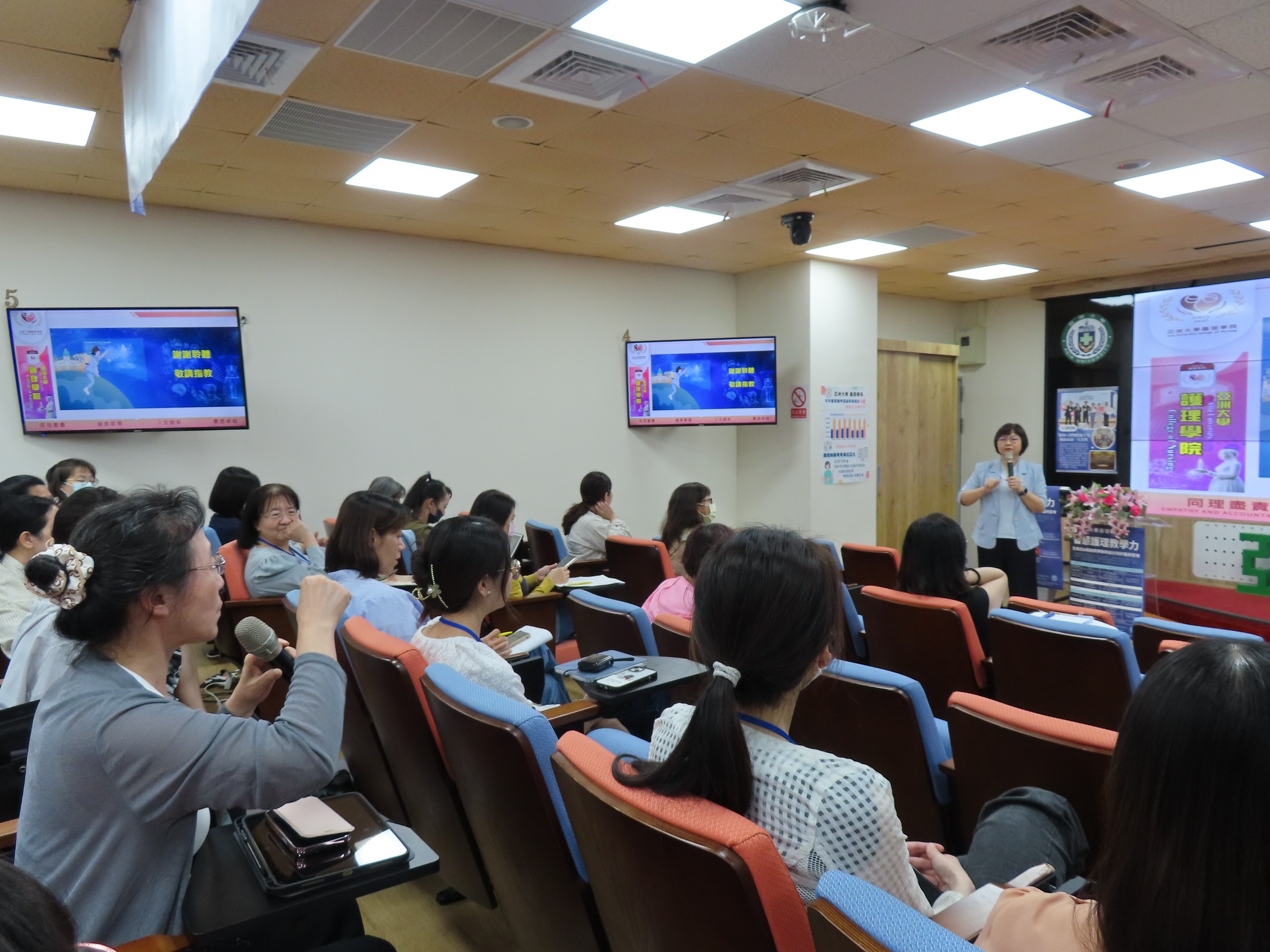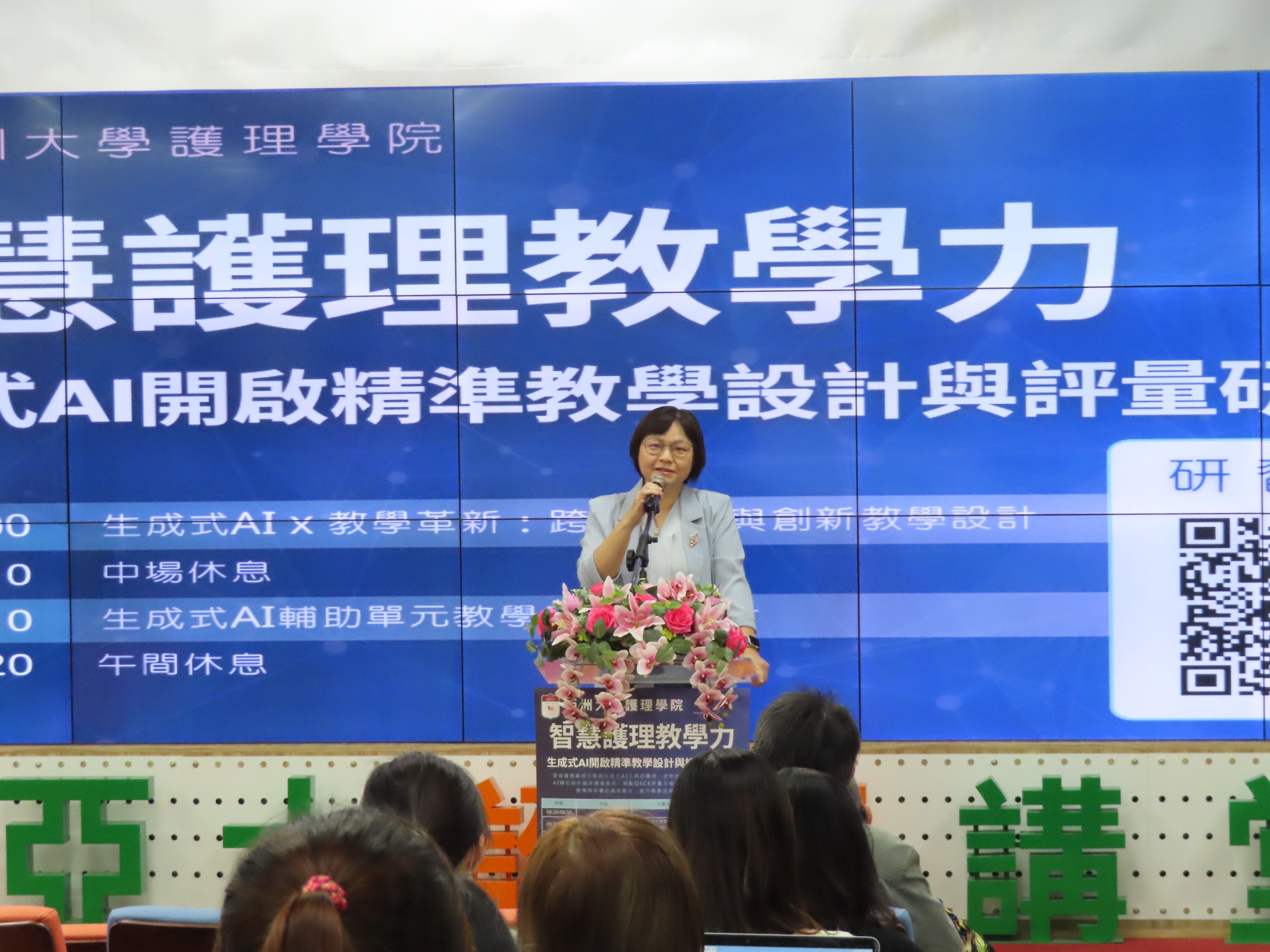
Asia University’s College of Nursing, in response to the rapid development of generative AI in the field of education, jointly organized the workshop “Smart Nursing Teaching: Generative AI for Precision Instructional Design and Assessment” with the University’s Office of Program for Promoting Teaching Excellence on October 18, 2025. Once the event agenda was released, it quickly attracted nearly 120 participants from across Taiwan, including department heads, faculty members, clinical instructors, graduate students in nursing, as well as supervisors and nurses from clinical institutions. Participants traveled from Taipei, Kaohsiung, Hualien, and other regions to Asia University to explore innovative teaching approaches and AI applications, successfully creating a new paradigm for smart education.
In her opening remarks, Dean Wu Hua-Shan of the College of Nursing stated that Asia University’s institutional development plan focuses on five major goals: “Smart Teaching,” “Smart Learning,” “Smart Research,” “Smart Campus,” and “Smart Hospital.” All colleges and departments continue to advance AI+X initiatives. The College of Nursing integrates AI and the metaverse into nursing education by embedding these technologies into teaching, counseling, research, industry collaboration, and recruitment. Through these efforts, the College has gradually built a distinguished reputation for its technology-enhanced nursing education brand, and this workshop serves as a platform for further exchange and collaboration with the broader community.
The workshop invited several distinguished scholars specializing in AI applications in education. In the morning session, Professor Lin Hao-Qiang from the Department of e-Learning Technology at National University of Tainan showcased his humorous and creative approach to generative AI video production. Combining modern poetry and artistic creativity, he demonstrated interdisciplinary and innovative teaching designs, emphasizing that creativity and depth stem from humanistic literacy and linguistic thinking, while AI serves as a supportive tool that opens new possibilities for educational innovation. Following this, Chair Professor and Vice President Li Kun-Chong from the Department of Buddhist Studies at Fo Guang University shared his experience in using generative AI to assist in instructional design and assessment planning, demonstrating the objectivity and precision of AI-generated assessment structures. He emphasized that teaching is a continuous improvement process, and the integration of generative AI enables educators to refine their practice more effectively.
In the afternoon session, the College of Nursing presented practical applications of generative AI in empowering nursing education. Distinguished Professor and Dean Wu Hua-Shan demonstrated how ChatGPT can be used with precise prompting to generate OSCE (Objective Structured Clinical Examination) clinical scenarios, tasks, standardized patient guidelines, and scoring rubrics—all completed in a single step. This significantly reduces the time required for instructors to prepare OSCE teaching plans, leaving participants impressed by the power of ChatGPT and the importance of precision instructions. Following this, Associate Professor Peng Yi-Ji from the Department of Nursing demonstrated how generative AI can guide students in designing nursing simulation scenarios, while Assistant Professor Wang Shu-Wei introduced the use of AI-generated virtual patients in the nursing process course, making nursing education more dynamic, immediate, and closely aligned with clinical practice.
The workshop delivered rich and diverse content, offering comprehensive insights into the applications of generative AI in instructional design, clinical assessment, and curriculum development. Participants widely expressed that the workshop not only broadened their perspectives on incorporating generative AI into nursing education but also provided practical strategies that can be immediately implemented in the classroom, positioning generative AI as a key driver in advancing smart education.